
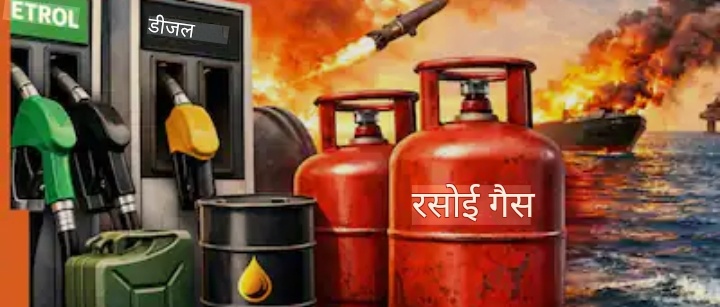
The invisible side of war

Manoj Singh
National Coordinator, Vichar Vibhag, AICC
OPINION | ECONOMY
NEW DELHI :War is often discussed in terms of borders, strategies and military strength. Headlines are dominated by victories and losses, territorial gains and shifting diplomatic alignments. Yet, beyond the battlefield lies another dimension of war—one that quietly permeates the daily lives of ordinary citizens.
This invisible dimension is economic. It slowly but steadily impacts household kitchens, family budgets and individual lifestyles, far removed from the frontlines of conflict.
At the heart of this impact lies energy—particularly oil. The modern global economy is deeply dependent on it. Whenever geopolitical tensions escalate, oil markets react with volatility. The immediate consequences are felt in transportation: road freight becomes more expensive, air travel costs surge, and supply chains face disruptions. Inevitably, the cost of goods—whether food or manufactured products—rises across the board.
The effects extend significantly into agriculture, the backbone of food security. Fertilizer production relies heavily on natural gas. Ammonia, a key input for fertilizers such as urea, is derived from gas. When gas prices increase, fertilizer costs rise, pushing up farming expenses. This chain reaction ultimately leads to higher food prices, placing a direct burden on consumers.
Oil, however, is not merely a fuel. It is embedded in the fabric of modern life. Plastics, packaging materials, synthetic textiles, pharmaceuticals and numerous industrial products depend on petroleum derivatives. As a result, any fluctuation in oil prices triggers a cascading effect across sectors, influencing production as well as consumption.
Rising costs compel businesses to increase prices, fuelling inflation. The impact is most severe on middle- and lower-income households. Budgets become strained, savings diminish, and essential expenditures are often curtailed. In this way, the economic consequences of war also exacerbate social inequalities.
For a country like India, the challenge is particularly acute. A significant portion of its energy requirements is met through imports. This dependence exposes the economy to global price shocks, leading to widening trade deficits, pressure on the currency and strain on public finances. Policymakers are thus confronted with the difficult task of balancing fiscal stability while providing relief to citizens in an uncertain global environment.
The effects of war, therefore, do not remain confined to distant borders. They enter homes—through rising cooking gas prices, increased transportation costs and the growing expense of daily essentials. The evidence is clear: the true cost of war is ultimately borne by ordinary people.
A stable and peaceful global order is not merely a diplomatic ideal; it is essential for economic resilience and social well-being. Recognising and addressing the economic consequences of conflict must remain a priority in an increasingly interconnected world.
⸻
The writer is National Coordinator, Vichar Vibhag, AICC. The views expressed are personal.